

Due to the Easter bank holiday, Your Week In Film is skipping a week, please accept this review in its place. NB: The review contains major (or should that be Major?) spoilers - see the movie and come back once you have...
Ghost In The Shell
Director: Rupert Sanders
Starring: Scarlett Johansson, Juliette Binoche, 'Beat' Takeshi Kitano
Running time: 1hr 47mins
Ghost In The Shell isn't a "guilty pleasure" - it isn't cheesy or one of those 'so bad its good' movies - but I'll admit a certain unease about enjoying it as much as I did. An intermittently terrific blockbuster, Rupert Sanders' film is nevertheless hobbled by a couple of major problems, its "white-washing" of the original Japanese manga and anime being easily the most egregious.
Ghost In The Shell isn't a "guilty pleasure" - it isn't cheesy or one of those 'so bad its good' movies - but I'll admit a certain unease about enjoying it as much as I did. An intermittently terrific blockbuster, Rupert Sanders' film is nevertheless hobbled by a couple of major problems, its "white-washing" of the original Japanese manga and anime being easily the most egregious.
Scarlett Johansson's casting in the lead role has been a bone of contention since it was announced a couple of years ago but that's only one item on the smorgasbord of insensitivity on show here. Johansson is Major Mira Killian, the first human to have her brain successfully implanted and integrated into a powerful and durable robotic body by a shady company, called Hanka Robotics, in a near-future Japan, where human and AI are increasingly interchangeable.
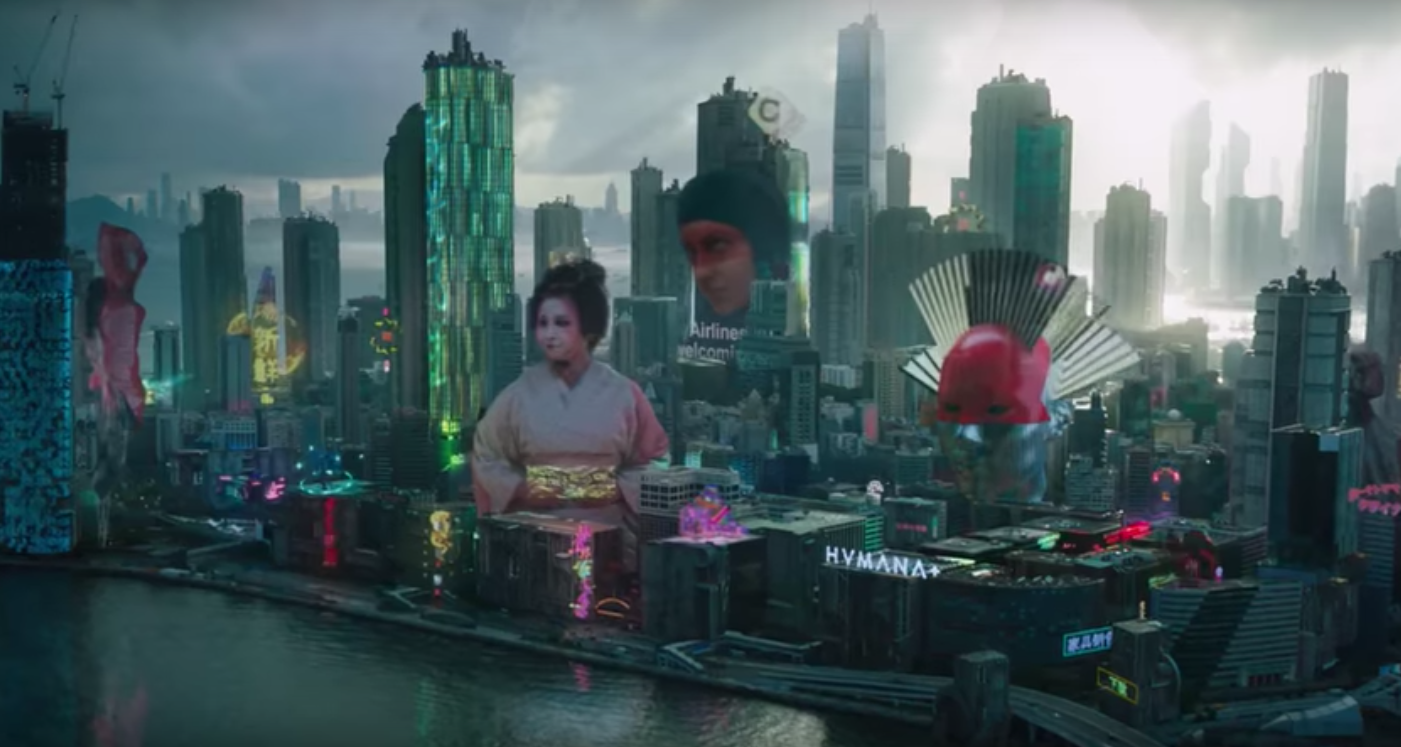
Future shock: Ghost's production design is its strongest feature
Recruited as an agent into an anti-terrorist government team called Section 9, she is soon on the trail of an endlessly resourceful bad-guy hacker known only as Kuze. But Major starts to experience 'flashbacks' (initially dismissed as glitches in her programming) and comes to realise that the personal backstory and memories she's been fed by her 'designer' Doctor Ouélet (Juliette Binoche) are not really hers. In fact, she isn't a refugee left for dead by terrorists in an attack on a boat at all, but a Japanese political activist, named Motoko Kusanagi, who has been seized and carved up on the orders of Hanka CEO, Mr Cutter (Peter Ferdinando).
If this version of Ghost is about anything, it's the suppression of self and identity, and like Stanley Kubrick's A Clockwork Orange, how abhorrent and unnatural such a thing truly is. That's a perfectly good theme for a science fiction film to tackle and has lots of possibilities for plot, characterisation and conflict. Unfortunately, when part of the story mix is that your protagonist has had her racial identity erased, you need to tread very lightly indeed. The film's producers fail to do so and casting the popular white lady from The Avengers franchise instead of a Japanese actress a bit more like the character in the original story is only the start.

Geisha assassin: The restaurant battle is one of Ghost's best scenes
Director Sanders and his team want to have their cake and eat it, hoping that if they make the film "a bit Japanese" then no one will notice the outrageous liberties they are taking elsewhere. Yes, Ghost is set in Japan, and there are some geisha robots and a bit of Japanese dialogue here and there and, oh look, there's the legendary 'Beat' Takeshi Kitano (Sonatine). But, the much loved actor/writer/director aside, Japanese characters are pretty much invisible throughout, and with only a few visual tweaks this could have been a near-future Los Angeles or New York. In fact, I completely forgot Section 9's sole Japanese field agent (Chin Han's Togusa) was even in the film until he cropped up for a second time towards the end.
The film's apologists (and, by the end of this review, I will have surely become one of them) have pointed out that the Major in the original manga or anime didn't look like a typical Japanese woman but both works were in Japanese, took place in Japan, and were entirely populated by Japanese characters. I get that Sanders and his team were perhaps trying to portray a truly multicultural future society, and that would be fine if films were made in a vacuum, in which real-world problems and sensitivities were irrelevant. But we don't and they aren't.
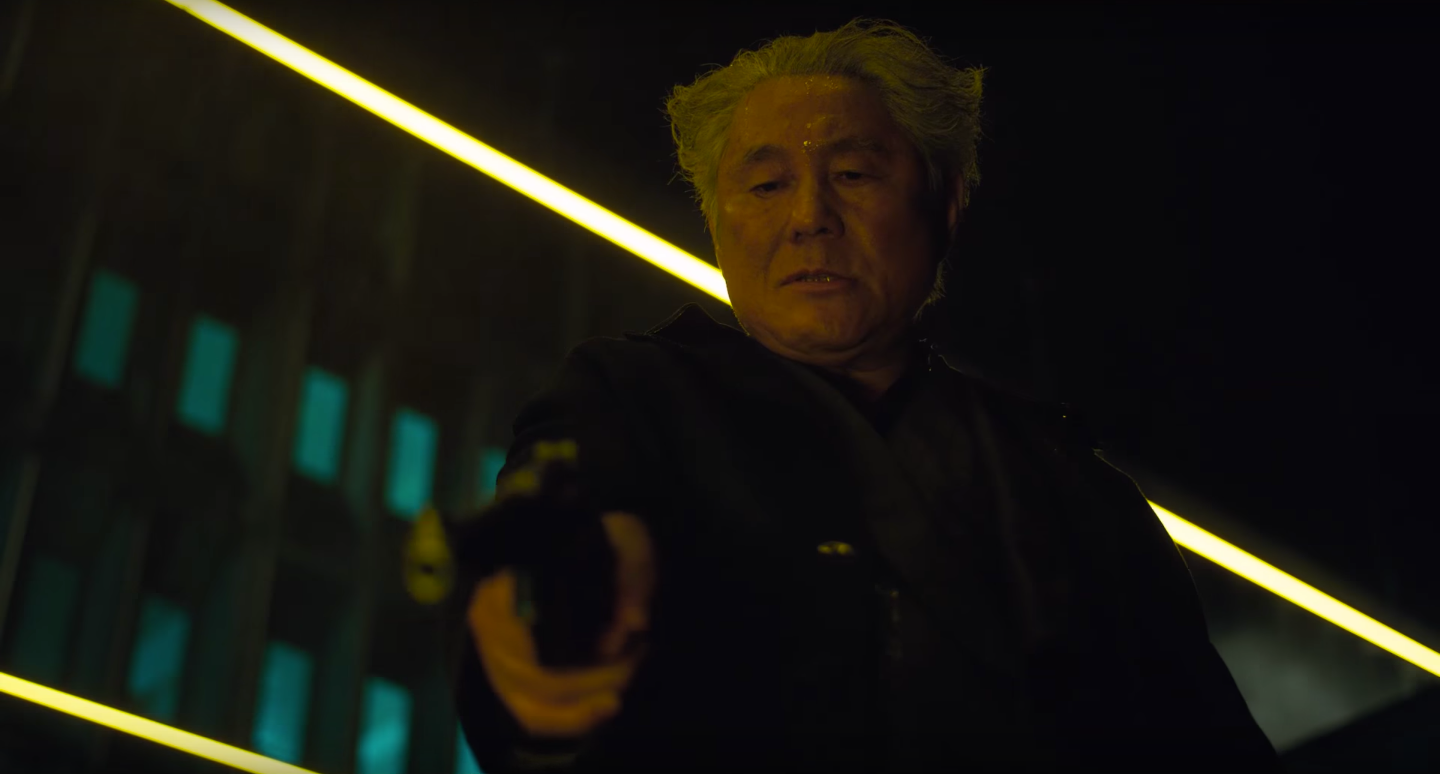
The Beat goes on: Takeshi Kitano is one of few Japanese cast members
It perhaps wouldn't be so bad if anything about Major's personality, demeanour, or even the language she speaks, changed after she regains the memories of her original Japanese self. But she's still precisely the same character as she is at the beginning, even though we're told she was once a political dissident who hated the increasing integration of human and machine. So, why does she carry on working for Section 9, then? It isn't so much a plot hole as a vast canyon through which you could drive a herd of stegosaur.
More easily forgivable is an 'identity crisis/everything you know is wrong' plot that lends the film an overfamiliar, even formulaic, tone. Ghost really does contain a lot of stuff we've seen before in the likes of Paul Verhoeven's Total Recall and Robocop, Denis Villeneuve's Enemy, Ridley Scott's Blade Runner, The Wachowskis' The Matrix, the Jason Bourne films, plus lesser-known sci-fi treats such as Vincenzo Natali's Cypher. You could probably make your own list of entirely different films, TV shows, novels, and comic-books with similar themes because there's an awful lot of it out there. In fact, I don't really understand why they didn't just go with the story from Shirow Masamune's original manga - an artificial intelligence known as the Puppet Master takes up residence in Major's brain - which was rather more interesting and could easily have been adapted for the screen.

The eyes have it: Section 9 operative Batou (Pilou Asbæk)
So, what are we left with? Surprisingly, quite a bit that's very good. Even if you can't get past the casting and the overused plot, the movie's mind-boggling production design makes Ghost worth seeing at least in 2D (I don't do 3D so can't speak to that version). The visuals might not have the gritty texture of Blade Runner - a sci-fi world which made you feel its dirt under your fingernails and the pungent aroma of its food market in your nostrils - but stun all the same. Monstrous advertising holograms tower over a beautifully realised cyberpunk dystopia, living billboards that seem almost threatening in the way they dominate the city scape like weird, sponsored kaiju. You could say it all looks like a glorified video game (or a Luc Besson daydream) but that doesn't detract from the sheer audaciousness of a design that nods to the original anime whilst doing something entirely its own.
This is not so much an adaptation of Mamoru Oshii's 1995 film or Masamune's original manga, but more a radical remix. It takes ideas from both sources but simplifies and streamlines them for a multiplex audience. For all the anime's brilliance, there are moments when it judders to a halt as our protagonists stop to have a chat about self, consciousness, and the merging of human and AI. This is quicker, sleeker and, at times, all the better for it. It lovingly lifts shots and scenes from the 1995 film, throwing them into the mix complete with different contexts and interpretations. I was particularly struck by Major's one-sided punch-up with a Kuze-possessed refuse collector in the shallow waters surrounding the city, and her iconic drop down the side of a skyscraper at the start as she swings into action for the first time. Thrilling stuff, handsomely recreated from the original sources.
One thing that did amuse me was the clear nod to The Matrix in the restaurant shoot-out set-piece early in the film. Major battles some gun-wielding nasties plus a hacked geisha robot and I fully expected it to go full 'bullet time' at any moment, which would have only been fair as the Wachowskis' 1999 sci-fi spectacular was clearly influenced by Oshii and Masamune's work. It was almost as if Sanders was calling in an old debt.
I, Robot: Scarlett Johansson is Major Mira Killian
If, gun to head, you absolutely have to cast a Caucasian woman in the lead role, Johansson is the perfect choice. She's an old hand at slightly off-kilter sci-fi films - Lucy, Her, and Jonathan Glazer's magnificent Under The Skin - and is totally at home here as a result. Her Major only looks entirely at ease when she's in the middle of a shoot-out or a punch-up - elsewhere she's stiff, maladroit (just check out the way she walks) and uncomfortable in her own skin (which, of course, isn't hers at all). In perhaps the film's most touching scene we see Major explore the face of a human prostitute, tracing the contours of something that is alien and familiar to her all at once. It's a moment of nuance, of double-edged subtlety, in a film that could use a little more of it.
Ghost is a real curate's egg, then - awful and awesome in roughly equal measure. Its faults are frustrating, but the stuff that works is extremely impressive. As is the way with things now, Major ends the film transformed into some kind of superhero (complete with moody rooftop action pose and Batman-style soliloquy), no doubt in anticipation of a franchise that, considering the film's poor box office, will almost certainly never happen. Bearing in mind the controversy and ill will Ghost has attracted, maybe that's not such a bad thing.
Rating: WWW
Ghost In The Shell is in UK cinemas now
Ratings guide
WWWW - Wonderful
WWW - Worthwhile
WW - Watchable
W - Woeful
Ratings guide
WWWW - Wonderful
WWW - Worthwhile
WW - Watchable
W - Woeful

